
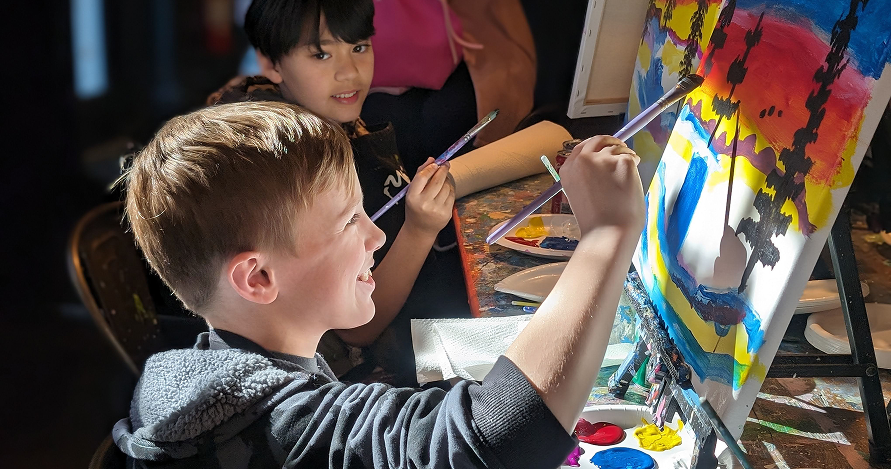
Summer break is long, screens are easy, and keeping kids genuinely engaged with something creative takes a little planning. Summer art activities for kids are one of the most effective solutions in that toolkit: they’re screen-free, they scale to almost any age, they work indoors and out, and they leave kids with something they actually made. Whether your goal is filling a rainy afternoon, channeling high energy into something productive, or just giving the household a break from the usual summer routine, a good art activity delivers on all of it. This guide covers 12 of the best options for summer 2026, from projects that need nothing more than a rock and some paint to a fully guided studio session with a professional artist.
The list is organized around two kinds of experiences: at-home summer art projects kids can tackle with basic supplies already in the house, and an out-of-the-house option at Muse Paintbar that brings the guided paint-and-sip format to families. Whether you’re looking for a quick backyard activity or a special summer outing with the kids, there’s something in here that fits.
Why Summer Art Activities Are Great for Kids
Art activities offer kids something that passive entertainment rarely does: the experience of making something from scratch and watching it come together through their own choices. That process builds fine motor skills through brush control, cutting, and manipulating materials, but it also develops creative confidence in a way that carries over into other areas. A kid who regularly makes things tends to approach problems with more flexibility and less fear of getting it wrong. Open-ended art projects in particular, where there’s no single correct result, teach kids to tolerate ambiguity and trust their own judgment, both of which are genuinely useful skills that go well beyond the craft table.
The developmental case for summer art is also a practical one for parents. Art activities hold attention in a focused, purposeful way that most passive entertainment doesn’t. A child working on a painting or a collage is practicing patience and concentration alongside creativity. And because art projects scale naturally in complexity, a single activity type can work for a wide age range at the same time: a four-year-old and a ten-year-old can both do watercolor painting, just at very different levels of ambition and detail. That flexibility makes summer art one of the most useful categories of activity a parent can lean on across the full length of summer break.
Summer Art Activities at a Glance
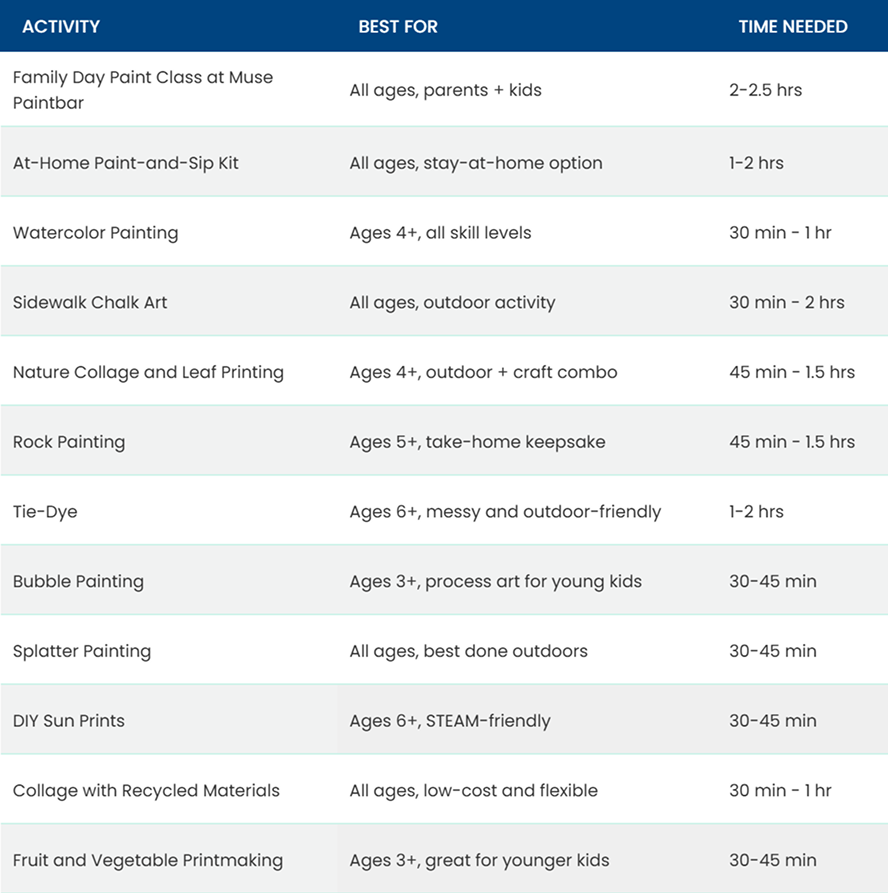
12 Fun Summer Art Activities and Ideas for Kids
From quick backyard projects to guided studio experiences, here are 12 of the best summer art activities for kids in 2026, covering a range of ages, energy levels, and supply budgets.
1. Bring the Kids to a Family Day Paint Class at Muse Paintbar
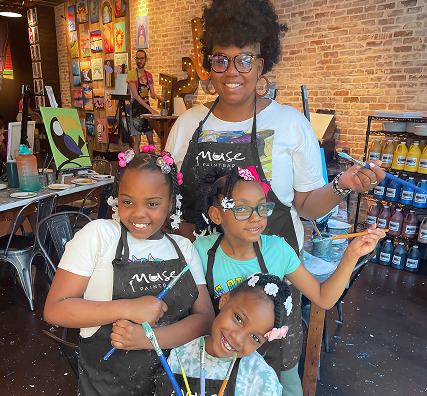
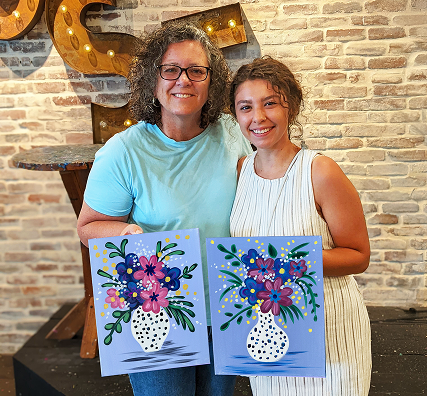
Muse Paintbar’s Family Day events are the standout out-of-the-house option on this list, and one of the most memorable summer art activities for kids that a parent can book. Family Day sessions are public painting classes specifically designed for families with children: a professional artist leads the group step by step through a painting theme chosen to work for all ages and skill levels, so a five-year-old and a twelve-year-old can sit at the same table and both walk away proud of what they made. No prior art experience is needed, and the studio environment is relaxed and welcoming rather than precious or pressure-filled. Parents and kids paint side by side, each working on their own canvas, which means everyone leaves with something real to hang on the wall.
Muse Paintbar recommends ages 5 and up for Family Day studio sessions, and all children under 13 must be accompanied by an adult. Sessions run two to two-and-a-half hours and move at a pace that keeps younger kids engaged without rushing older ones. For families who want a more dedicated group experience, such as a birthday party or a summer gathering with cousins or friends, Muse also offers private kids’ party bookings that give your group a dedicated space and a customizable painting theme.
Family Day events run regularly throughout the summer across Muse’s locations. Check the Family Day schedule at your nearest studio and book in advance, as summer sessions tend to fill up quickly. It’s the kind of summer outing that becomes a tradition.
2. Set Up an At-Home Paint-and-Sip Kit
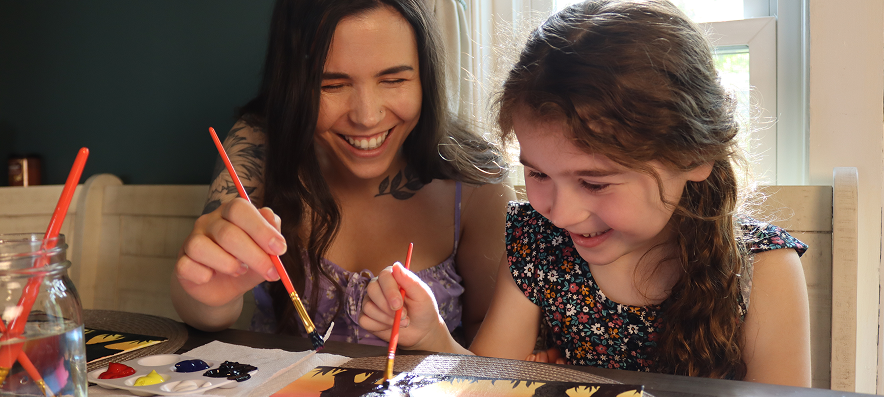
For families who want the guided paint-and-sip experience without leaving the house, the Muse Paintbar at-home kit is the easiest way to turn the kitchen table into a mini art studio. Kits are available at shop.musepaintbar.com and include everything needed: canvas, brushes, and paint, along with easy-to-follow video instructions so families can work through the painting at their own pace. It’s a particularly strong option on rainy days, heat-wave afternoons, or any day when getting out of the house feels like more effort than it’s worth. Kids of all ages can participate, and parents can calibrate how much guidance they offer based on the child’s age and interest level.
To make it feel more like an event than a craft project, set up the space with snacks, themed beverages for the kids (lemonade, juice boxes, “artist punch” in whatever color matches the day’s painting), and a playlist in the background. The at-home kit delivers a genuine Muse Paintbar experience on your own schedule, and each child ends up with a finished canvas they painted themselves. As summer art projects for kids go, it’s one of the easiest to set up and one of the most satisfying to finish.
3. Try Watercolor Painting
Watercolor painting is one of the most versatile and beginner-friendly summer art activities for kids, and it works for a wider age range than most parents expect. For summer-themed projects, try ocean scenes with layered blues and greens, simple sunset landscapes using wet-on-wet blending, flower gardens on a single sheet, or a still life of summer fruit. Older kids can explore detail and composition; younger ones can focus on color mixing and the way the pigment moves across a wet surface. A simple technique like pressing salt into a wet wash creates instant texture that looks impressive and delights kids of every skill level.
One supply note worth making: watercolor paper makes a significant difference in the finished result compared to printer paper, which tends to buckle and lose color intensity. It’s a small additional cost that pays off visibly. Find brushes, paint sets, and paper in the Muse Paintbar supplies shop to get started with quality materials that hold up to repeated summer use.
4. Make Sidewalk Chalk Art
Sidewalk chalk is one of the most accessible and endlessly open-ended summer arts and crafts activities for kids, and it requires essentially no setup. The driveway or sidewalk becomes the canvas, the cleanup is a garden hose, and the only limit is how much pavement you have available. Kids can draw and then erase by stepping on their work, collaborate on a neighborhood mural, trace their shadows at different times of day, or design elaborate imaginary worlds that take up the entire driveway. There are no wrong answers and nothing to waste.
It’s also one of the few activities that naturally draws multiple kids in at once without any coordination from parents. One child starts drawing, another wanders over with a piece of chalk, and within a few minutes everyone’s contributing to something collective. That organic collaboration is part of what makes sidewalk chalk such a reliable summer arts and crafts activity for kids across a wide age range.
Need inspo? Watch Muse Paintbar’s Sidewalk Chalk Techniques Video
5. Go Outside for Nature Collage and Leaf Printing
Nature collage and leaf printing is a two-part summer art idea for kids that starts outside and finishes at the craft table, which makes it feel like a full afternoon rather than just a quick project. Part one: take the kids on a short walk to collect leaves, flowers, feathers, seed pods, pebbles, and anything else that catches their eye. The collecting itself tends to slow kids down and get them looking closely at the natural world in a way that a directed walk rarely achieves. Part two: bring the materials inside and either press and glue them onto cardstock or canvas board to create a nature collage, or coat them with paint and press them onto paper to print their shapes and textures.
Leaf printing in particular is one of those summer art ideas for kids that consistently surprises children with how good the results look. The detail in a well-pressed leaf print, veins, edges, and all, tends to feel like magic the first time it works. The two-part format also suits a wide age range: younger kids love the collecting; older kids tend to engage more with the composition and arrangement.
6. Paint Rocks
Rock painting is a satisfying summer art project for kids precisely because the finished product is a three-dimensional, tactile object that can be displayed on a windowsill, given as a gift, or placed somewhere in the garden or neighborhood for someone else to find. Finding the right rock, one with a smooth, flat surface, is part of the activity, and kids tend to take that selection seriously. Summer-themed design ideas include watermelons with painted seeds, suns with radiating lines, beach scenes, simple animal faces, ladybugs, and abstract dot patterns inspired by indigenous Australian painting traditions.
Acrylic paint works best on rocks because it adheres to the surface and dries to a durable finish. A coat of Mod Podge or clear sealant after the paint dries makes the designs weather-resistant if the rocks are going outside. For families who want to turn the project into a community activity, painted rocks placed along a neighborhood walking path with a note on the bottom inviting the finder to take or rehide them is a warm and low-cost summer tradition worth starting.
Want a tutorial? Watch Muse Paintbar’s Rock Painting Video
7. Try Tie-Dye
Tie-dye is a classic summer arts and crafts activity for kids that has genuinely earned its place on the list: it combines hands-on color experimentation with a wearable, usable result that kids want to show off. The basic process is straightforward: rubber band sections of a white cotton item (t-shirt, tote bag, pillowcase), apply the dye in sections using squeeze bottles, let it set wrapped in plastic for several hours, then rinse, unwrap, and reveal. Tie-dye kits come with everything needed and require minimal prep beyond setting up the workspace.
The key detail with tie-dye as a summer arts and crafts activity for kids is to plan for mess and set up accordingly. Do it outside on a surface that can get stained, use gloves throughout, and have a designated rinsing area. Once those logistics are in place, the activity is largely self-directing: kids can follow basic folding patterns or freestyle their own rubber banding, and both approaches produce results they’ll be proud of. Few summer art projects have as high a ratio of effort to payoff.
8. Make Bubble Painting
Bubble painting is one of the most process-oriented and age-accessible activities on the entire summer art list, and it works especially well for toddlers and preschoolers who are too young for more structured projects. The technique is simple: mix dish soap, water, and liquid watercolor or food coloring in a shallow container; kids blow through a straw to create a dome of bubbles above the rim; then press a sheet of paper gently onto the surface to transfer the bubble prints. Each press creates a different cluster of overlapping rings in whatever color the mixture was dyed.
The activity works beautifully as a multi-station setup where several color combinations sit side by side, and kids move from one to the next pressing the same piece of paper into each. The layered result tends to look considerably more sophisticated than the effort involved suggests. For families with older siblings, bubble painting is one of the few activities that genuinely works for a 3-year-old and a 10-year-old at the same time, just with different levels of intentionality about the composition.
Want more bubble painting tips? Watch Muse Paintbar’s Easy Bubble Art Tutorial
9. Try Splatter Painting
Splatter painting is the most physically energetic summer art project on this list, and for a lot of kids, that’s exactly the point. The technique is loose and freeing: load a brush with paint and flick, drip, or throw it onto a canvas or large sheet of paper laid flat on the ground. Repeat with different colors until the surface is full. The result tends to look genuinely striking, and kids feel the satisfaction of having made something that looks like art rather than a craft project.
The Jackson Pollock-style approach works best done outdoors on a tarp or a large sheet of paper or cardboard taped to the ground. Dress kids in clothes that can be ruined, set up the surface in a spot with some clearance on all sides, and then step back. As summer art projects for kids go, splatter painting is the one most likely to produce actual screams of joy and paint in someone’s hair. That’s a feature, not a bug.
10. Create DIY Sun Prints
Sun print art is one of the most STEAM-friendly summer art ideas for kids because the science of what’s happening is as interesting as the visual result. Kids arrange flat objects, such as leaves, flower petals, keys, coins, feathers, or cut paper shapes, onto sun-sensitive cyanotype paper, then carry the sheet outside and leave it in direct sunlight for a few minutes. When brought inside and rinsed in water, the paper reveals a striking blue-and-white silhouette print of whatever was arranged on it. The contrast is sharp and the results look intentional and beautiful even when the arrangement was completely random.
Cyanotype paper is inexpensive and widely available, and the full process takes less than fifteen minutes from setup to finished print. The finished pieces look polished enough to frame, which makes them one of the better summer keepsake projects on the list. For kids who want to go deeper, the science of photosensitive materials and UV light exposure is a natural extension conversation that turns a craft activity into something genuinely educational.
11. Make a Collage with Recycled Materials
A recycled materials collage is the lowest-barrier summer art activity on this list: the supplies are household recycling, scissors, and glue. Cardboard tubes, egg cartons, newspaper, fabric scraps, bottle caps, tissue paper, plastic lids, and old magazine pages all become materials once kids start looking at them that way. The open-ended nature of the format means every result is completely different, and kids who might disengage from a structured painting activity often thrive with the freedom to invent their own compositions.
The activity also carries a natural sustainability lesson without requiring a formal discussion about it. Kids who spend an afternoon turning what was headed for the recycling bin into something they’re proud of start to see everyday objects differently. For families looking to make it more structured, giving kids a theme, such as “build a city,” “make an animal,” or “create a garden,” adds just enough direction to keep the project moving without constraining it.
12. Do Fruit and Vegetable Printmaking
Fruit and vegetable printmaking is the most kitchen-friendly activity on the list and one of the easiest to set up around snack time or meal prep. Cut fruits and vegetables in half, dip the cut surface in paint, and press onto paper to reveal the natural patterns inside. A halved apple shows its star-shaped seed pattern; celery cut at the base prints a rose-like rosette; citrus slices make detailed circular prints; corn cob rolled in paint creates a textured grid pattern. The variety of shapes and prints available from a typical summer kitchen is genuinely surprising.
Frame this as a summer produce activity as much as an art activity: talk about what’s in season, look at the patterns inside different vegetables before dipping them in paint, and discuss why a potato makes a solid stamp while a cucumber makes a juicier one. A series of fruit and vegetable prints arranged into a summer banner or greeting card makes a strong finished project that uses all the individual prints together. For younger kids especially, this is one of the most naturally joyful summer art ideas available, and the only cleanup is the cutting board and a few paint dishes.
Tips for Setting Up a Summer Art Space at Home
A little setup at the beginning of summer makes it much easier to say yes to art activities throughout it. Here are four practical tips for building a home art environment that holds up for the full season.
Designate a space for messy projects.
Having a dedicated spot for messy activities removes the hesitation that slows most art sessions down before they start. A folding table on the patio, a corner of the garage, or a section of the kitchen with a plastic tablecloth on the floor underneath it works well as a standing setup. Outdoor space makes cleanup significantly easier for the messiest activities on this list: splatter painting, tie-dye, and bubble painting are all best done where a hose is nearby.
Keep a basic supply kit stocked and accessible.
Supplies that are easy to reach get used. Keep a basic standing kit somewhere kids can get to it without asking: washable tempera paint in a range of colors, a watercolor set with real watercolor paper, a variety of brush sizes, canvas boards or cardstock, glue sticks, and scissors. Having the basics in reach means kids can start a project independently rather than waiting for a parent to locate everything. It also makes it easier to say yes when the impulse to create arises spontaneously.
Rotate activities to maintain interest.
Even the most engaging activity gets repetitive if it’s the only option available. Rotating through different types of summer art, painting one day, outdoor chalk the next, a nature collage later in the week, keeps the summer art routine from feeling like an obligation. A simple list on the refrigerator or a visual menu that kids can look at and choose from gives them ownership over the rotation and reduces the “what should we do?” conversation considerably.
Mix in a guided in-studio experience.
At-home art is flexible and convenient, but a guided out-of-the-house session offers something different: professional instruction, a proper studio environment, and the energy of painting alongside other families. Muse Paintbar’s Family Day events bring parents and kids into a studio led by a professional artist, working through a painting step by step together. As a summer treat to book once or twice across the season, it’s the kind of experience that raises the ceiling on what kids think they’re capable of making.
Summer Art Activities for Kids FAQs
What are the best summer art activities for kids?
The best summer art activities for kids combine creative engagement with age-appropriate accessibility and don’t require a lot of specialized supplies or parental setup. For families looking for a guided, out-of-the-house experience, Muse Paintbar’s Family Day events are the strongest option: professional instruction, a welcoming studio, and a finished canvas to take home. For at-home summer art activities for kids, watercolor painting, sidewalk chalk, rock painting, and bubble painting are all strong starting points that work across a wide age range.
What summer art projects can kids do at home?
There’s a strong range of summer art projects for kids that require minimal supplies and no specialized setup. Watercolor painting, sidewalk chalk art, rock painting, bubble painting, splatter painting, tie-dye, fruit and vegetable printmaking, and recycled materials collage are all accessible at-home options covered in this guide. Most can be done with supplies already in the house or with a small purchase from a craft or grocery store.
What summer art activities are best for young children ages 3 to 6?
For younger children, the best options are process-oriented and low-barrier: bubble painting, fruit and vegetable printmaking, and sidewalk chalk all work well for ages 3 and up with minimal parental involvement. The Muse Paintbar at-home kit is also a strong option for this age group when parent-led, with the video instructions keeping the session structured and paced appropriately. For in-studio Family Day sessions, Muse recommends ages 5 and up, and all children under 13 must be accompanied by an adult. These summer art ideas for kids in the younger range prioritize fun and exploration over finished results.
Does Muse Paintbar have events for kids and families?
Yes. Muse Paintbar’s Family Day events are public painting sessions specifically designed for families with children of all ages and skill levels. A professional artist leads the group step by step, and kids leave with a finished canvas they painted themselves. Private kids’ party bookings are also available for birthday parties, summer gatherings, and other dedicated group experiences.
What summer arts and crafts supplies should I keep on hand?
A useful basic kit for summer arts and crafts for kids includes washable tempera paint in a range of colors, a watercolor set with real watercolor paper, canvas boards or cardstock, brushes in multiple sizes, glue sticks, and scissors. Most activities in this guide require only a subset of those supplies, and several, like sidewalk chalk, recycled materials collage, and fruit printmaking, require almost nothing from the list. Keeping summer arts and crafts supplies accessible and stocked throughout the season makes it much easier to follow through when the impulse to create comes up.
Find a Muse Paintbar Family Day Near You
Summer is the best time to lean into creative activities with kids, and the ones that tend to stick are the ones that combine making something with genuine time together. A finished painting, a tie-dyed shirt, a collection of printed rocks: those physical reminders of an afternoon spent creating carry more weight than a passive day ever does. Building a few of those moments into the season, across different formats and energy levels, makes for a summer that feels full in a way that screen time rarely achieves.
When you’re ready to bring the family into a proper studio, Muse Paintbar’s Family Day events are the place to start. Sessions are designed for all ages and skill levels, a professional artist guides the group from blank canvas to finished painting, and no experience is needed. Every child walks out with something they made themselves, which tends to be the most-talked-about part of the whole outing. Find a Family Day session at your nearest Muse Paintbar location and book your spot before summer fills up.
For families who prefer to stay home, the Muse Paintbar at-home kit brings the same guided experience to your kitchen table, with all supplies and video instructions included.
Book Your Family Day Muse Paintbar Experience
Browse upcoming sessions, learn about private events, or get in touch with our team.
Find A Location
AT-HOME KIT
See More
March Into Creativity: Spring Painting Ideas
Seasonal Scenes
How Paint and Sip Events Can Cure the Winter Blues
Get Inspired
Creative Valentine’s Day Gift Ideas
Gift Ideas
STAY INSPIRED
Let us help you find your Muse with new paintings, promotions and special events.



Paint with us
Locations
Public Events
Private Events
Mobile Events
Virtual Events
Merch
DIY Paint Parties
Paint At Home
Paintings
Art Prints
Supplies
Gift Cards
Learn More
Blog
About Us
Rewards
Food & Drinks
Careers
FAQS


